When One Corner of a Louisville House Drops: Piers, Rock and Karst
Settling is a different problem from bowing. Instead of a wall leaning in, one part of the house moves down. The usual fix is piers, and Louisville's ground adds two questions many cities never ask: how close is the rock, and was there ever a sinkhole here?
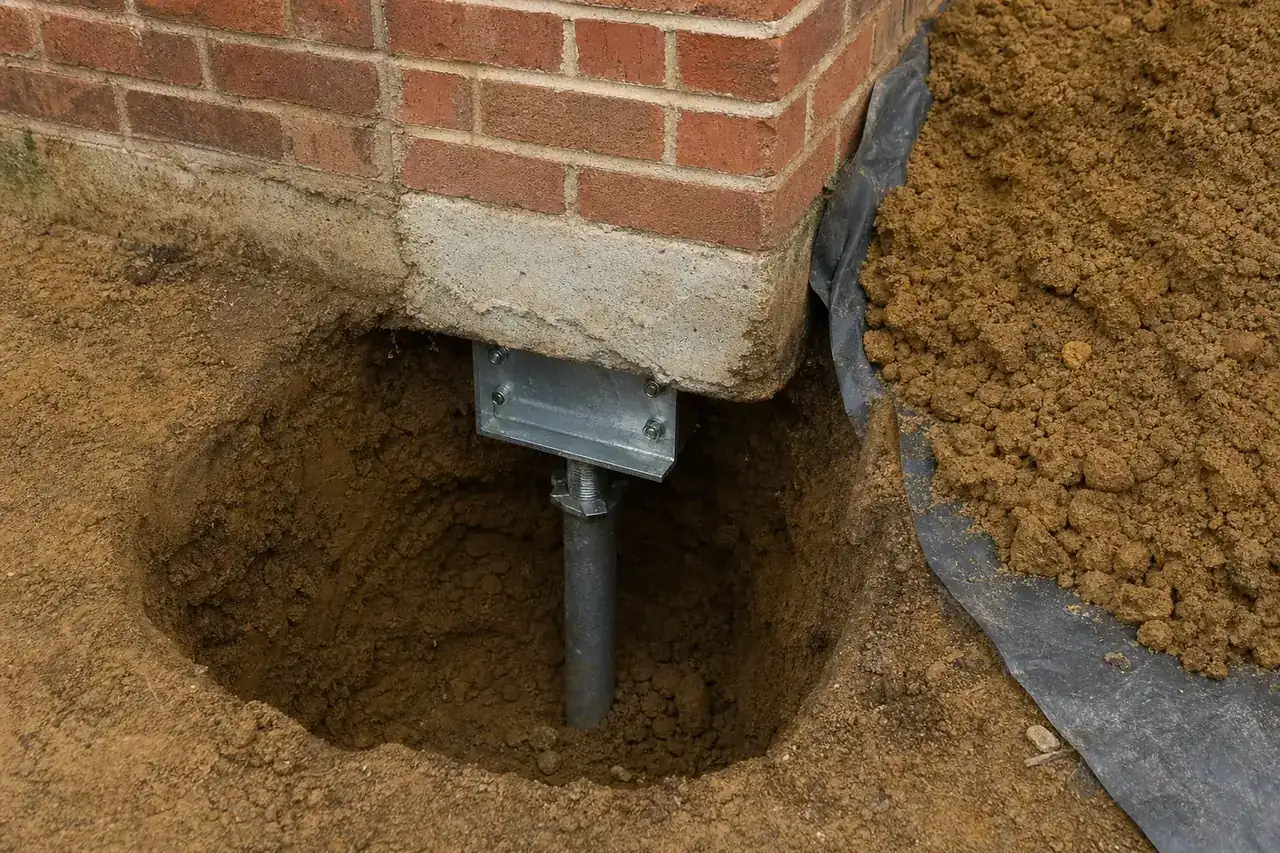
Settling foundation repair in Louisville usually means steel push piers or helical piers under the part that dropped. Fixr (2026) prices piers at $1,000–$3,000 each, HomeGuide (2025) puts helical piers at $2,000–$4,000 each, and HomeGuide (2026) gives $4,500–$20,000 for a settling repair.
Is my foundation settling, or is a wall bowing?
- Settling: brick cracking in steps at an outside corner, a crack wider at the top than the bottom, door frames out of square, a floor that runs downhill toward one wall, a gap opening between a porch or stoop and the house.
- Bowing: a long sideways crack in a block basement wall and the wall leaning in at the top. That is covered on the bowing walls page.
Some houses have both. Note which signs appeared first and where.
Why part of a Louisville house sinks
- A filled sinkhole. The Kentucky Geological Survey warns that homes built over sinkholes filled during land clearing or construction may be damaged as the fill keeps washing out underneath.
- Water at one corner. A downspout or a low spot that sends roof water to one footing softens the soil there, and in karst areas it can carry soil down into cracks in the rock.
- Clay drying unevenly. After a dry stretch the clayey upland subsoils shrink, most at outside corners where they dry from two sides.
- Soft ground by water. Flood-plain soils such as Nolin are young river deposits (USDA NRCS), and poorly packed fill around any house can settle for years.
Push piers or helical piers on Louisville ground?
Steel push piers are driven down beside the footing using the weight of the house as the counterforce, until they meet enough resistance to carry it. Helical piers are screwed in by a hydraulic drive head and set by torque, so they also work under light loads such as porches and small additions. On upland soils such as Faywood and Caneyville, limestone can lie only 20 to 40 inches down (USDA NRCS), so piers may reach rock quickly; on the river terraces, Wheeling soils sit over sand and gravel and firm bearing can be much deeper. A good plan names the type, the count, the spacing and the target depth or load, and records the final depth of each pier. Published prices are in the Louisville foundation repair cost guide.
What if a sinkhole opens near or under the house?
The Kentucky Geological Survey's guidance is plain. If a cover collapse develops under a building, shore up the foundation as quickly as possible, usually by carrying the load down to solid bedrock. The hole itself can then be filled more slowly with a graded filter, layers of rock and gravel that let water keep draining while holding the soil back. KGS says to consult a professional geologist experienced in karst and an engineer experienced in sinkhole repair. Do not dump dirt into it or aim a downspout at it. KGS also asks homeowners to report new collapses, even ones only a foot across.
Questions homeowners ask
Do piers have to reach bedrock in Louisville?
Not always. Push piers are driven until they meet enough resistance to carry the house, which on the limestone uplands may be rock and near the river may be dense soil far down. Helical piers are set by torque instead. Where a sinkhole is involved, KGS guidance is to carry the load to solid bedrock. Ask for the final depth of every pier in writing.
Describe what you are seeing
Two or three lines is enough: roughly when the house was built, whether the basement is block, poured or stone if you know, and what changed. A wall leaning in, brick cracking at a corner, water along the floor after rain. One independent specialist who works around Louisville reads it and gets in touch.