Louisville and Jefferson County, Kentucky
Foundation Repair in Louisville Starts With the Ground Under Your House
Louisville foundation repair looks different on limestone uplands in the eastern county than on river sand near the Ohio or on shale slopes in the southwest. This guide sorts the common problems by ground and by house age, explains each fix in plain terms, and lists published prices with their sources.
Most Louisville foundation repair is a bowing basement wall, a settling corner or water coming in. A typical job runs $2,200–$8,200 in Fixr's 2026 guide, and HomeGuide (2025) prices wall anchors at $80–$150 per foot. The Kentucky Geological Survey has mapped 1,104 sinkholes in Jefferson County.
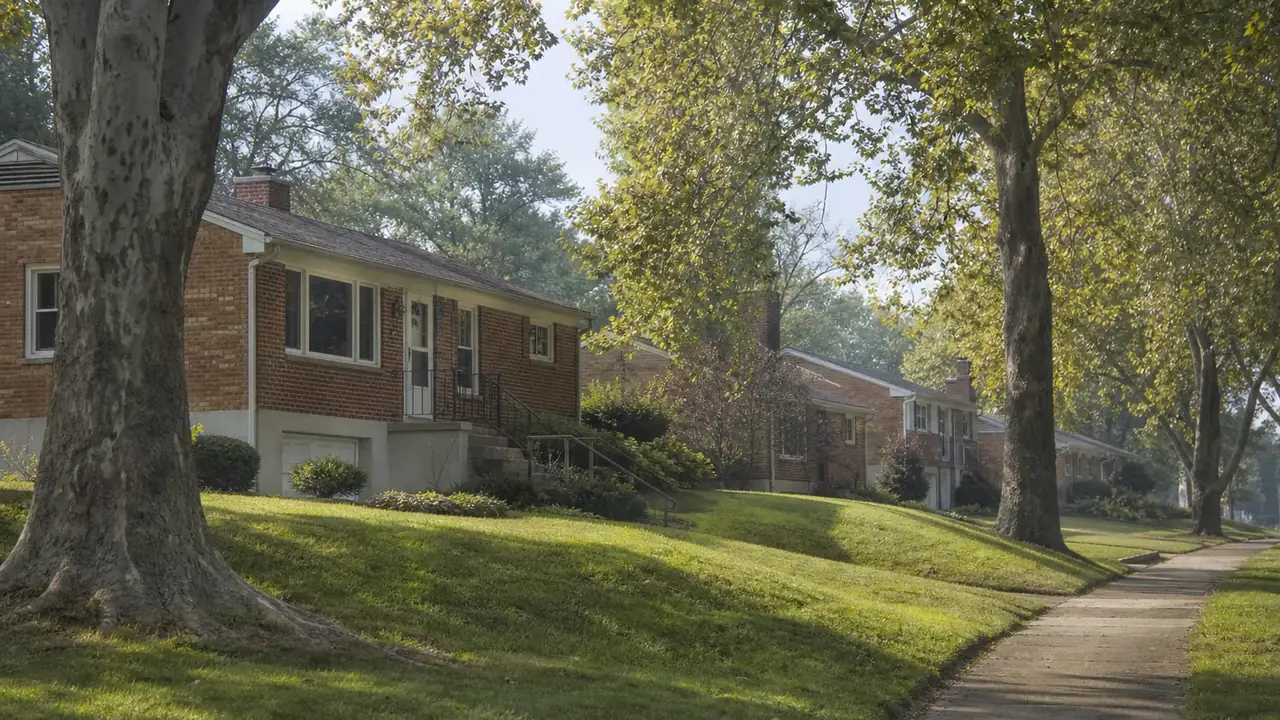
Louisville foundation repair, sorted by the ground beneath the house
The federal soil survey of Jefferson County reads like three towns stitched together. On the uplands of the eastern and central county, the common named soils, such as Crider, Faywood and Beasley, are silt and clay over limestone or shale, and the Kentucky Geological Survey places the county's karst there. Faywood is only 20 to 40 inches deep before it reaches bedrock (USDA NRCS).
Near the Ohio River the ground turns to river deposits. Wheeling soils on the terraces are loam over sand and gravel, and Nolin soils fill the flood plains; they barely swell, but water is their problem. In the southwest, Shrouts soils formed from shale, and the state survey notes drainpipes and limestone riprap placed on the shale slopes of the Muldraugh Escarpment near the Gene Snyder to keep them from slipping (KGS).
How the soil survey rates Louisville land for a house with a basement
The USDA rates every soil for dwellings with basements. Of the Jefferson County land it rates, about 64% is very limited, 29% somewhat limited and only 7% not limited. Shrink-swell is cited on about 57% of the rated acres, a high water table on 45%, and flooding on 21% (USDA NRCS Soil Data Access, survey version September 2026). About a third of the county is mapped simply as urban land, where pavement and buildings cover the soil, and is not rated.
Clay that swells pushes on a basement wall from outside, and water held in it adds weight and freezes near the surface. Louisville's airport station averages 74 nights a year at or below 32°F but only about 13 days that stay below freezing all day (NOAA 1991–2020 normals), so the top of the ground freezes and thaws again and again through a winter.
Three problems, three pages
- Bowing basement walls: anchors, braces, straps or tiebacksHow each method holds a leaning wall, which suits block, poured or old stone, and what to measure first.
- A corner that sinks: piers, rock and karstSigns of settling, why corners drop on Louisville ground, push or helical piers, and what to do if a sinkhole opens.
- Basement waterproofing, starting with MSDSeep, sewer or river? Downspout incentives, drains and sumps, floodplain permits and backwater valves.
- What foundation repair costs in LouisvillePublished ranges for anchors, braces, piers, drains and sumps, plus the Metro permit formula and the MSD downspout incentive.
Worth reading before any bid
- Louisville's ground: limestone, shale and river sandWhere the karst is, how many sinkholes the state has mapped, the river terraces, and how the soils rate for basements.
- Watch it, measure it, or ask: foundation signsTen things Louisville homeowners notice, each sorted by how much attention it needs, with the page that covers the fix.
- Selling or buying after foundation workWhat Kentucky's seller disclosure form asks about foundations, basements and drainage, and which papers to keep.
Houses from every decade, and foundations to match
Louisville's median home dates to 1971, 61% of its 289,095 homes predate 1980, and about 45,000 were built in 1939 or earlier (U.S. Census ACS 2020–2024). The oldest commonly stand on brick or rubble limestone laid in soft lime mortar; mid-century ranches often have concrete block basements; newer houses lean toward poured concrete. Each fails in its own way. Mortar washes out of old stone, block walls crack along a joint and lean in, and poured walls more often crack and leak than bow. See bowing basement walls and basement waterproofing.
Karst in Louisville: real, but measured
The Kentucky Geological Survey's LiDAR mapping counts 1,104 sinkholes in Jefferson County. That is real karst, though far less than Hardin County to the south, with nearly 16,000 (KGS). Across Kentucky the soil over limestone is usually less than 25 feet thick, so cover collapses wider than 20 feet are uncommon. Cracked drywall and out-of-square doors can go with a forming sinkhole, but University of Kentucky extension specialists point out that clay shrinking and swelling causes the same signs. Measure before assuming either. The guide to Louisville's ground has the detail.
Where your request goes
This is a reference and referral site, and nobody behind it inspects, engineers or repairs a house. Fill in the form and it reaches one independent foundation and waterproofing specialist working around Louisville, who pays the site per referral. There is no charge to you for asking, and other bids remain open to you.
Questions homeowners ask
How deep do footings go under a Louisville house?
The Kentucky Residential Code sets 24 inches as the minimum frost-protection depth for footings in Jefferson County (Table R403.1.4). Houses built before modern codes may sit shallower, and a full basement puts the footing much deeper anyway. Shallow footings under porches, stoops and small additions are the ones most often nudged by frost and wet clay.
Is a dip in my Louisville yard a sinkhole?
It might be. The Kentucky Geological Survey has mapped 1,104 sinkholes in Jefferson County and describes karst geology in the eastern and central county. A new bowl-shaped depression or arch-shaped cracks in the soil are the warning signs KGS lists. Keep downspout water away from it, have a geologist or engineer look if it sits near the house, and report a new collapse to KGS.
Why does my block basement wall crack in one long sideways line?
A long horizontal crack in a block wall, often near mid-height, usually means soil outside is pushing the wall inward. Wet clay and frost add to the push. A crack that stays the same width may only need watching. One that widens, or a wall that leans in at the top when you hold a level against it, needs a specialist's look.
Sources
- Kentucky Geological Survey: Jefferson County land-use planning issues
- Kentucky Geological Survey: karst map layers and LiDAR sinkhole outlines
- USDA NRCS Web Soil Survey (Jefferson County, Kentucky)
- U.S. Census Bureau, ACS 2020-2024: year structure built, Louisville
- University of Kentucky Cooperative Extension AEN-126: Common Hazards in Karst Terrain
Describe what you are seeing
Two or three lines is enough: roughly when the house was built, whether the basement is block, poured or stone if you know, and what changed. A wall leaning in, brick cracking at a corner, water along the floor after rain. One independent specialist who works around Louisville reads it and gets in touch.