Bowing Basement Walls in Louisville: Anchors, Braces, Straps or Tiebacks
A basement wall that cracks along a block joint and leans in at the top is being pushed by the soil outside it. Several methods hold such a wall, and each suits a different wall, a different lot and a different amount of movement.
Bowing basement wall repair in Louisville usually means wall anchors, steel braces, carbon fiber straps or helical tiebacks. HomeGuide (2025) prices anchors at $80–$150 per foot of wall and tiebacks at $300–$360 per foot; Fixr (2026) puts a typical bowed-wall job at $4,000–$15,000.
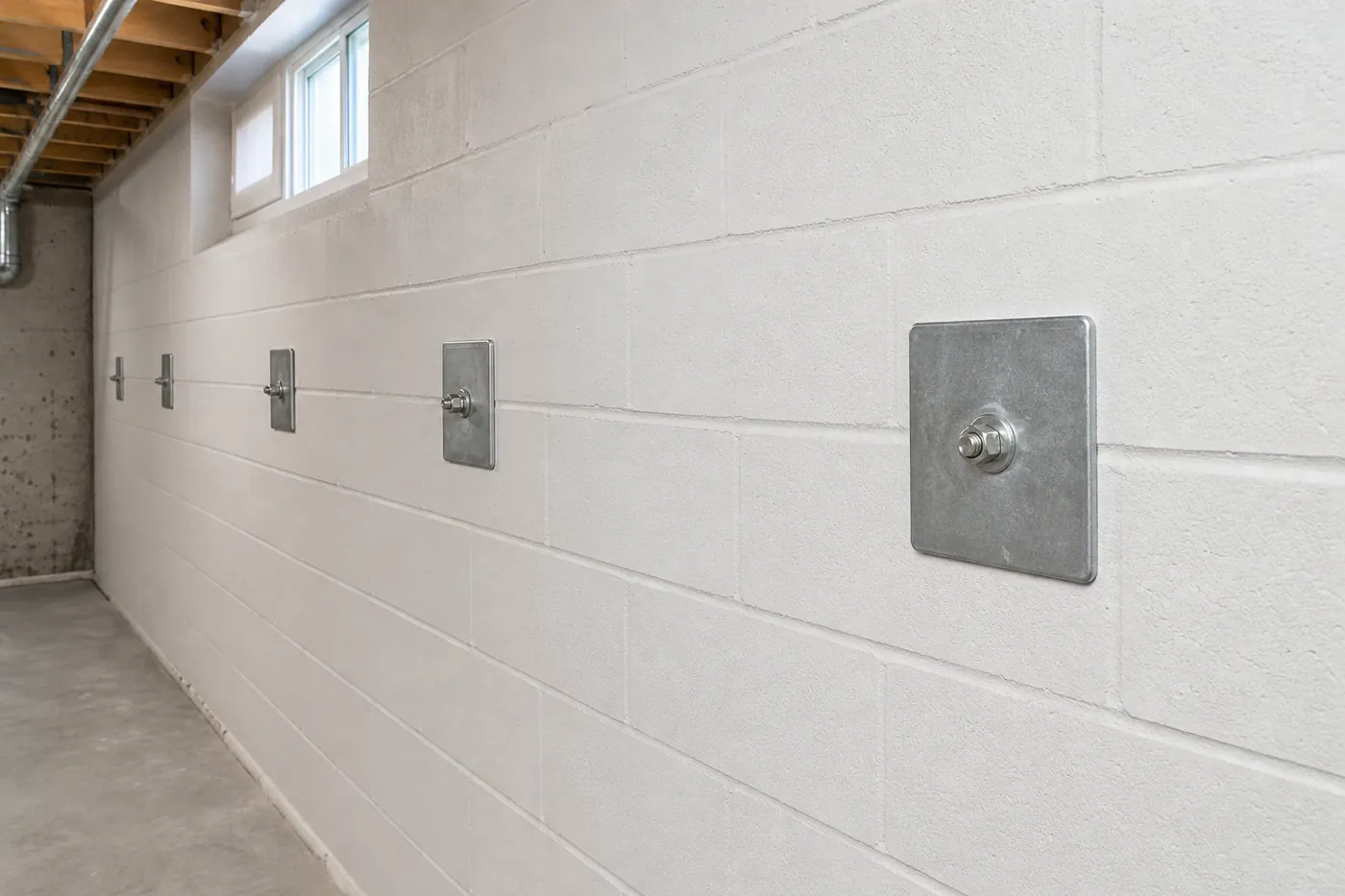
Why do Louisville basement walls lean in?
The push comes from the ground. Many of the county's upland soils turn clayey with depth, and the soil survey's measure of swelling, linear extensibility, reaches about 6% in Crider and Faywood and 5.7% in Beasley, against 1.5% in the sandy Wheeling soils by the river (USDA NRCS). Wet clay swells and gets heavy. Louisville averages 12.8 days a year with an inch or more of rain and 74 nights at or below freezing (NOAA 1991–2020 normals), so the soil against a wall is often saturated and the top of it often frozen. A downspout emptying beside a corner concentrates both. Block walls give first along a mortar joint, which is why the crack runs sideways.
How does each bowing basement wall repair hold the wall?
- Wall anchors. A steel plate on the inside of the wall connects through a rod to a second plate buried in firm soil out in the yard. HomeGuide (2025) describes them for bowing under 2 inches, set about every 5 feet. They can be tightened over time.
- Steel braces. Vertical steel beams bolted to the floor and to the framing above. Nothing is dug outside, but the beams take up floor space along the wall.
- Straps. Carbon fiber or steel strips bonded or fastened vertically, usually every 4 feet. They lie flat and suit walls with mild to moderate bowing that have not moved far.
- Helical tiebacks. Screw-like steel rods driven at an angle through the wall into the soil outside, from inside the basement. HomeGuide lists them for bowing of 2 inches or more.
- Straightening or rebuilding. The soil is dug away outside, the wall is pushed or rebuilt plumb, and new drainage goes in before backfill. HomeGuide (2025) puts straightening at $340–$550 per foot.
Which fix fits your wall and your lot?
- How far has it moved? Hang a plumb line or hold a long level top to bottom and note the gap at mid-height. Small movement leaves more options.
- Block, poured or stone? Block bows along joints, poured concrete more often cracks than bows, and stone needs its own approach (below).
- What is outside the wall? Anchors need open yard; a driveway, patio or neighbor's line points toward braces, straps or tiebacks.
- Is the basement finished? Braces take floor space; straps sit nearly flush.
- Is water coming through too? Plan the drain and sump at the same time. Prices are side by side in the Louisville foundation repair cost guide.
Old stone and brick foundation walls
About 45,000 Louisville homes were built in 1939 or earlier (U.S. Census ACS 2020–2024), and many of the oldest have foundations of rubble limestone or brick in lime mortar. These walls do not behave like block. Loose stones can shift around an anchor plate, and hard modern mortar can crack old brick. The usual work is repointing with a compatible mortar, rebuilding a bulged section, or bracing designed for that wall. Ask the specialist how often they work on stone or brick foundations and whether an engineer should design the repair; Kentucky engineers can be checked on the state licensing board's public roster.
Questions homeowners ask
Can a bowed basement wall be pushed back to straight?
Sometimes, at least partly. Wall anchors can be tightened in stages, often in drier months, to draw a wall back gradually. Full straightening means digging outside, which HomeGuide (2025) puts at $340–$550 per foot. Braces and straps stop further movement rather than undo it, so ask each company whether its plan stops the wall or moves it back.
Describe what you are seeing
Two or three lines is enough: roughly when the house was built, whether the basement is block, poured or stone if you know, and what changed. A wall leaning in, brick cracking at a corner, water along the floor after rain. One independent specialist who works around Louisville reads it and gets in touch.